“International Dimensions of Strong Corporate Cultures” – Friday, April 1, 2016, Austin, TX
March 30, 2016
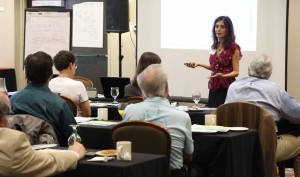 I’d like to cordially invite you to my luncheon presentation on “International Dimensions of Strong Corporate Cultures” this Friday, April 1, at ACC Highland Mall in Austin, TX. The free event, the second of the Global Business Luncheon Series, is sponsored by the World Affairs Council in partnership with the International Business Institute at ACC. My focus will be on the commonalities of organizations with great business cultures no matter whether in the U.S. or elsewhere in the world.
Details:
- Speaker: Carrie Vanston, Corporate Cultures That Rock
- Subject: “International Dimensions of a Strong Corporate Cultures“
- Date: Thursday, April 1, 2016
- Time: 11:30 am-1:00 pm
- Location: ACC Highland Learning Center, Room 2216
- 6101 Airport Blvd, Austin, TX 78752. (In the new ACC wing)
We often concentrate on differences, but similarities are as important, if not more, because they form the foundation for all of our relationships. We ALL want to connect with each other, be appreciated for what we do, and have a higher purpose that impacts the world.
This talk provides five keys that create, grow, and sustain great corporate cultures and suggest ways you can increase your own culture quota. These keys include connecting, developing, discovering. collaborating, and, finally, transforming.
For more details and to register, click here. Hope to see you on Friday!
Warm regards,
Carrie
P.S. Please feel free to contact me if you’d like a similar sample presentation or a 1/2 hour free consultation on improving your organization’s culture! I’d love to hear from you.
_______
Carrie Vanston helps organizations, large and small, maximize purpose and connection to create better performance and profit. She is a consummate connector, who enjoys bringing like-minded people together to share, learn, and grow through advice, workshops, presentations, coaching, and facilitation. She is the developer of “Five Keys to an Engaged & Innovative Culture”? and co-author with Dr. John H. Vanston of the award-winning book MINITRENDS: How Innovators & Entrepreneurs Discover & Profit From Business & Technology Trends.
Carrie Vanston presents “5 Keys to an Engaged & Innovative Culture” at CTXWFS, May 27, Austin, TX
May 26, 2015
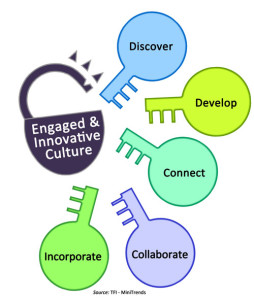 Come hear me speak on “Five Keys to an Engaged and Innovative Culture” at CTXWFS on Wed, May 27, 7pm at Café Express, 3418 N. Lamar Blvd in Austin, Texas! No charge or need to register. Food and beverage available for purchase, but please arrive early to order. Details below. Hope to see you there!
Warm regards,
Carrie
Five Keys to the Engaged and Innovative Culture of the Future
By Carrie Vanston
This presentation provides individuals and organizations five key ways to create and grow an engaged and innovative culture that is cutting-edge, while increasing retention, productivity, employee and customer loyalty, and profitability. A strong purpose, vision, and the inclusion of all stakeholders is vital to accomplish these goals.
Attendees will gain an understanding of why companies that establish and maintain innovative cultures are the ones most likely to succeed and thrive. They will learn practical ways for staying ahead of the latest industry trends and for creating a caring environment that encourages the highest engagement of an organization’s most important resource – the creativity of its employees.
Speaker Bio for Carrie Vanston
Carrie Vanston is VP of Communications and Culture Coach at Technology Futures, Inc. She excels at helping clients create and grow innovative cultures that succeed and thrive by staying on the cutting edge of industry trends with maximum engagement by all stakeholders. She is a consummate connector, who enjoys bringing like-minded people together to share, learn, and grow. Carrie is Co-Author of the award-winning book MINITRENDS: How Innovators & Entrepreneurs Discover & Profit From Business & Technology Trends. Recent articles by Carrie have appeared in Texas CEO Magazine and the Austin Business Journal.
Note from Carrie:
We at TFI have been enthusiastic supporters/members of CTXWFS and its parent World Future Society for many years. These are wonderful organizations for those who see foresight as an important way to improve our businesses and our world. We appreciate CTXWFS and WFS for sponsoring our 2012-2014 MiniTrends Conferences and providing excellent CTXWFS speakers including Steve Pearson, Wayne Caswell, Jeffrey Fry, and Joyce Gioia. Long-time Contributing Editor to WFS’s The Futurist Magazine, David Pearce Snyder, was so well-received as our 2012 Keynote, we had him back in 2014! Dr. John Vanston, David, and I did Master Courses in 2013 and 2014 at WFS’s annual WorldFuture Conference. This year I am honored not only to be speaking on the Five Keys here at CTXWFS, but also at July’sWorldFuture 2015 in San Francisco. Thanks, CTXWFS and WFS!
Central Texas World Future Society: Formed in 2003, CTXWFS is a nonprofit educational and networking organization. Members come from all walks of life, professions, ages and experiences. We are drawn together by a common desire to learn how emerging issues, disruptive technologies, ongoing trends and current events interact to shape our collective future.
5 Keys to an Engaged and Innovative Culture by Carrie Vanston, Texas CEO Magazine – January Issue
January 30, 2015
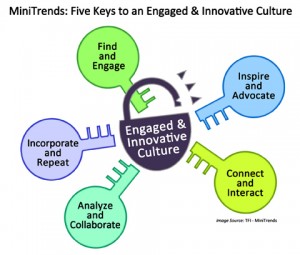 My Texas CEO Magazine article “MiniTrends: Five Keys to an Engaged and Innovative Culture” is up! The article discusses 5 ways to combine the process of finding emerging trends with engaging employees in order to improve your culture and bottom line.To stay successful, organizations must constantly look for the latest emerging trends and incorporate the most relevant ones into their business strategy. Not surprisingly, the organizations most likely to thrive are the ones that have the highest engagement of their most important creative resource — their employees.
- Find and Engage
- Inspire and Advocate
- Connect and Interact
- Analyze and Collaborate
- Incorporate and Repeat
I’d love to hear your thoughts on the article and would appreciate your sharing the link with your contacts! 🙂
Warm regards,
Carrie
Carrie Vanston, VP Communications
Technology Futures, Inc. – MiniTrends
P.S. Thank you to the wonderful Publisher of Texas CEO Magazine, Pat Neikamp, for including me in this excellent magazine. She is an absolute pleasure to work with.
Carrie Vanston is Vice President of Communications at Technology Futures, Inc. and Co-Author of MINITRENDS: How Innovators & Entrepreneurs Discover & Profit From Business & Technology Trends. She excels at helping clients create and grow innovative cultures by finding and profiting from emerging trends with maximum engagement by all stakeholders.
Favorite Takeaways From Roy Spence of The Purpose Institute & GSD&M Speaking at ABJ’s Face-2-Face AKA Straight From the Top
January 13, 2015
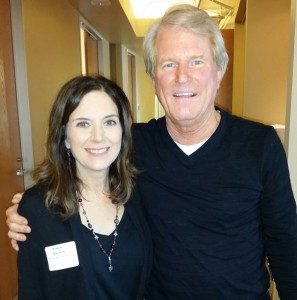
Roy Spence with Carrie Vanston after his Face-2-Face Interview
I had the pleaure of attending the Austin Business Journal’s Face-2-Face Breakfast last week at Whole Foods featuring the very funny and inspiring Roy Spence, Co-Founder and Chairman of GSD&M, a leading marketing communications and advertising company here in Austin. He is also Co-Founder and CEO of The Purpose Institute and author of the Wall Street Journal bestselling book It’s Not What You Sell, It’s What You Stand For: Why Every Extraordinary Business is Driven by Purpose. He was interviewed by the always delightful Colin Pope, Editor of the Austin Business Journal, and host of F-2-F. Face-2-Face airs on Time Warner TV on Sunday mornings in Austin under the name “Straight From the Top.”
Here are my favorite takeaways from this great interview:
Roy’s mentor and customer Herb Kelleher, Founder of Southwest Airlines, taught him “Take the competition seriously, but not yourself.” He has also been greatly inspired by author Jim Collins’ book Built to Last.
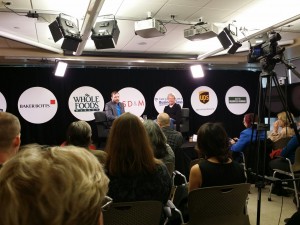
Colin Pope, Austin Business Journal, interviews Roy Spence for Face-2-Face, also known as TV show Straight from the Top
Roy calls the group that has taken on much of GSD&M’s day to day business responsibilities “The Eagles” because you should always be building a better nest. Eagles work first for customers, then company, then community, and then world. The Eagles carry out the vision and purpose that is set, but do so in the way THEY see fit.
Purpose is most important. Always have a purpose beyond making money. Your purpose is where your talents meet the needs of the underserved. Start with integrity and everything else can be taught. It’s all about engaging with integrity, honor, and respect.
GSD&M’s Purpose: Create visionary ideas that make a difference.
With their campaign “Don’t Mess with Texas,” GSD&M created a 76% drop in litter by appealing to pride not litter. It’s not the litter business, its the pride business.
With Southwest they found purpose was not about flying, it was about freedom.
You’re only as young as the new stuff you do. Roy’s mother always told him, “Be great at what you’re good at, don’t be average at what you’re bad at.” Play to your strengths and encourage your kids to do the same. “What do you love to do?”
Smallness can be a huge asset, embrace it. Transform yourself to be happy, not necessarily big. Aristotle stated “Where your talents and the needs of the world cross; there lies your vocation.” When starting out, your biggest asset is naivety because you are not already set in your way of perceiving things.
Roy wrote the book 10 Essential Hugs of Life to encourage fathers to hug their children and encourage people to embrace life. Some of the essential hugs are yourself, your family, your friends, your flag, your coach/teacher/mentor, your mind/heart/future, etc. Fully embrace your journey because the destination will get here faster than you think. Whenever you get lost, you’ll find yourself in the service of others.
You become what you look for. Roy hit the road and took a picture of something good every hour and found lots of good things! If you look for friends, you’ll find them, etc.
Politics is the business of freedom. If we can get the government to agree on a higher ground that we can do better at satisfying the purpose of our nation and not just coming up with tactics.
The purpose of business is to improve life. In visionary mode you do well and are liberated. In self mode, not so much. How does Roy make decisions? He tries to look around the corner. What postive impacts will a decison make? If negative impacts, he walks away.
Don’t reinvent or rebrand your company, it’s about transformational change. You keep or find your vision and purpose and keep that intact.
By creating value for all stakeholderrs, more value is created for shareholders. An alternate to the traditional business model of only maximizing profit for shareholders, Whole Foods has been very successful with what CEO John Mackey calls “conscious capitalism.” With Whole Foods great success, the new model is catching on as a movement.
GSD&M has “Correction of Errors” meetings. “Hug your mistakes. The ‘failures’are the character flaws. Fess up when you mess up.”
Roy likes people who like him. His mother said there are honey people and vinagar people. He likes honey people.
Marry the dreamers and the doers. Look for people with shared values. It makes no sense to him when people say don’t be partners with friends. Who makes better partners? He loves people who enjoy winning – in a good way. Take the “Strengthfinder” test and look for your partners that complement you.
Thanks to ABJ, the sponsors, and Roy Spence for sharing this fun and insightful morning.
I hope everyone had a wonderful holiday! Best wishes for a Happy New Year!!
Warmly,
Carrie
P.S. If you missed our home-made holiday card, check it out! We’ve been designing our own holiday cards for many years now around an interesting current event or trend. This year’s celebrates the Philae robot landing on a comet. The verse is always by Our Chairman Dr. John Vanston, design by our Creative Director Helen Mary V. Marek. (Past cards are linked at the bottom of that page.)
John & Carrie on BOSS-Talks — Free Webinar – Mon., Nov 10, 12-1 CST
November 7, 2014
BOSS-Talks: Tech Tools Free Webinar:
“MiniTrends: Trends Inside Trends”
with Dr. John H. Vanston and Carrie Vanston
- How and where to search for MiniTrends.
- How to evaluate the business attractiveness of a MiniTrend.
- How to develop an effective MiniTrend Strategy.
- How to turn the strategy into profitable business opportunities…
-
 You should participate if you are:
- A Corporate Intrapreneur seeking strategies to keep your organization on the cutting edge of business and technology.
- An Entrepreneur wishing to identify, assess, and exploit attractive new business opportunities.
- An Innovative Thinker interested in gaining recognition for originality and perceptiveness.
- An Investor interested in uncovering attractive new investment opportunities.
- A Job Seeker wishing to define emerging employment possibilities.
Participants will recieve a solid basis for developing their own “MiniTrends Mindset.”
|


Tech Tools Webinar Host: BOSS-Talks’ Dr. Jan Triplett and Business Success Center provide ramp up assistance for new businesses and scaling for growing businesses.
|
_________________________
MiniTrends 2014: Thank You, Slides & More
October 29, 2014
Thank you to everyone who had a part in making MiniTrends 2014: Insight, Innovation & Strategy such a huge success! The speakers were fantastic, the synergy between attendees exciting, and the overall response great. Now let’s build on the connections we made and all we learned!
We want to give special thanks to our Keynotes David Pearce Snyder, Brett Hurt, and Dr. John Vanston. They brought to life our theme of the importance of foresight and culture for the success of organizations. Ditto to Dr. Jani Byrne, Joyce Gioia, and our distinguished panel.
 We also greatly appreciate our wonderful Sponsors and Partners, as well as our Planning Committee and Advisory Board for their integral role in making this such a valuable and fun event.
Conference slides are up! We will post conference pictures of the sessions, meals, and reception on our MiniTrends Facebook soon. We are also preparing a video of the proceedings for purchase.
Thank you to those attendees who turned in an Evaluation Sheet. If you didn’t, please fill it our now by clicking here. We take your comments very seriously for future planning.
 Join our LinkedIn MiniTrends Group and/or guest blog on our MiniTrends Blog to share thoughts about the conference and your own minitrends, experiences, and resources. Twitter is @MiniTrendsBook, #minitrends.
We welcome feedback on the book MINITRENDS: How Innovators & Entrepreneurs Discover & Profit From Business & Technology Trends that attendees received at the conference. (A quick read of the Preface (Page xxi) and Chapter 10 (Pg 185-186) gives a good overall theme of the book.) MINITRENDS also available on Amazon.

Please keep us in the loop on your activities and how you are applying methods and ideas you picked up at the conference and in the book. We use examples in our talks, blogs, and/or they may be speaking subjects for you next year.
Also please let us know if we might bring a MiniTrends Mindset to your organization through a presentation, workshop, and/or other in-house services. We want to know the direction you are heading and how we and the MiniTrends Community can help you get to where you want to be. We look forward to continuing the conversation.
IBM’s Dr. Jani Byrne joins MiniTrends 2014 (Sept 26) – Special $150 rate ends Noon Monday Sept 22
September 19, 2014
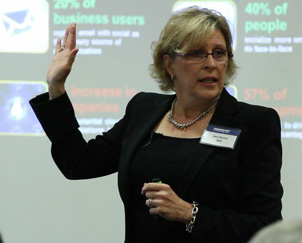
Dr. Jani Byrne
Director of Marketing, Cloud, IBM
We are delighted that Dr. Jani Byrne, Director of Marketing, Cloud, at IBM has joined the program for our 3rd annual MiniTrends 2014: Insight, Innovation & Strategy. Jani will be sharing her experiences as corporate innovator in her talk “Musings of a Wild Duck in a Big Pond.”
Jani is responsible for Content Marketing globally for Cloud, one of IBMs leading strategic initiatives, creating and distributing consumable, relevant content to drive client acquisition and purchase. Previously she served as IBM’s Director, Marketing Strategy for Global Mid-Markets MSPs and Director, Strategy.
Jani is on the Boards of The Seton Fund at the Seton Family of Hospitals’ and Austin Chamber of Commerce Technology Partnership.
Register Now for special price for full conference of only $150 until noon, Monday, September 22.
Our Keynotes are Austin Tech Leader and Bazaarvoice Founder Brett Hurt, top D.C. Futurist David Pearce Snyder, and award-winning author Dr. John Vanston. Also headlining is USA TODAY’s Road Warrior of the Year Joyce Gioia.

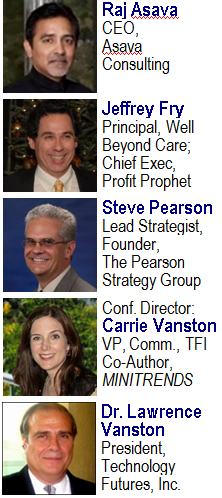 We have an excellent applications panel on how to turbo-charge your success and profit by combining MiniTrends methods with your innovation strategy. Panelists include Raj Asava, Jeffrey Fry, Steve Pearson, Carrie Vanston, and Larry Vanston.
The breadth and depth of the speaking talent and schedule for this awesome event it exceptional. In addition we have incredible attendees who are thought-leaders in their own right. (See what our past attendees say.) We hope you, too, will be part of the this year’s amazing event.
MiniTrends 2014: Insight, Innovation & Strategy.
Friday, September 26, 2014
8:30 am – 5:30 pm followed by “Power Hour” Reception
Holiday Inn Lady Bird Lake, Austin, TX
Full Conference for Only $150
(Special ends Noon, Monday, Sept. 22)
All attendees receive Continental Breakfast, Breaks,
and Lunch followed by a Networking Reception!
Please share offer with your friends, colleagues & networks.
MiniTrends’ ABJ Article – “Here’s how to stay on top of ‘minitrends’ and get ahead of the pack”
September 9, 2014

Austin Business Journal Article and Image – “Here’s how to stay on top of ‘minitrends’ and get ahead of the pack” by Dr. John Vanston and Carrie Vanston – Image from Austin Business Journal
Be sure to check out the Austin Business Journal article by Dr. John Vanston and Carrie Vanston entitled “Here’s how to stay on top of ‘minitrends’ and get ahead of the pack.” Find out how to stay on the forefront of emerging trends in your industry and quickly recognize and appreciate those trends and take advantage of them through action — and fast.
To find out even more about how you can do more with less, work smarter, not harder, game the system, and become that “Rock Star” you always hear about, attend MiniTrends 2014: Insight, Innovation & Strategy on Friday, September 26, in Austin, Texas.
Take advantage of the special limited rate of just $150 for a full day including lunch and a “power hour” reception packed with top speakers like Bazaarvoice founder Brett Hurt, IBM Marketing Director Dr. Jani Byrne, world-renowned futurist David P. Snyder, award-winning author Dr. John Vanston, and USA TODAY’s Road Warrior of the Year Joyce Gioia — Use code “Special150-2014″ (until Sun Sept 21) or click here. Student rate also available.
Meet John & Carrie at WorldFuture 2014 in Orlando
June 17, 2014
 MiniTrends’ leaders Dr. John Vanston and Carrie Vanston are excited to be conducting a day-long Pre-Conference Master Course at the World Future Society’s annual conference WorldFuture 2014: What If? Our Master Course, MiniTrends and Macro-Change: Turbo-Charging Your Future, also includes our co-presenter and long-time partner, the highly-esteemed futurist David Pearce Snyder and will be held on Thursday, July 10 from 9:00 am – 5:00 pm.
 This inspring day begins with David describing the changing world and the forces driving it. He helps you see the future through a matrix of many emerging trends – MiniTrends – that reflect the macro-changes that you must anticipate to be successful as the future unfolds.
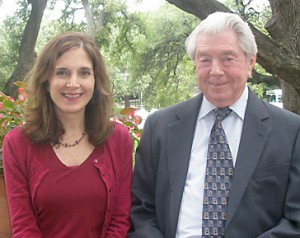
Dr. John Vanston & Carrie Vanston
presenting Pre-Conference
Master Course at WorldFuture 2014
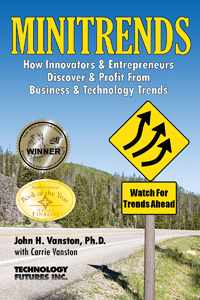
John and Carrie, authors of the award-winning book MINITRENDS: How Innovators & Entrepreneurs Discover & Profit From Business & Technology Trends, then provide you with the foundation for a strong MiniTrends process with seven ways for you to find, analyze, and profit from important minitrends and their potential business opportunities.
Participants will leave this course with an understanding of:
- How predictable forces are rapidly reshaping our demography, economic structure, productive technologies, and decision-making processes.
- How monitoring these forces can enable participants to identify and profit from emerging trends and attractive business opportunities.
- How participants can apply the information, ideas, and insights presented in this course to guide their business, cause-related, personal, and investment decisions.
We hope you will join us in Orlando for WorldFuture 2014: What If? and our Pre-Conference Master Course: MiniTrends and Macro-Change: Turbo-Charging Your Future.
VOTE for MiniTrends Panel for SXSW Eco 2014 by May 16 – “Creating a Profitable & Purpose-Driven Business”
May 11, 2014
PLEASE take a moment to VOTE for MiniTrend’s panel submission for SXSW Eco Conference titled “Creating a Profitable and Purpose-Driven Business” at http://panelpicker.sxsw.com/vote/29857 by May 16.
The panel includes Carrie Vanston, VP, Communications, MiniTrends/TFI; Jeffrey Fry, Chief Executive, The Profit Prophet; Andre Angel, Founder/CEO, TangoTab; and Joy Miller, Marketing and Outreach Coordinator, City of Austin Small Business Development Program..Short videos of each panelist can be found at http://vimeopro.com/
A third of the decision is directly from votes! You do have to sign in, but it does not take long to vote. Please go to http://panelpicker.sxsw.com/vote/29857 and VOTE NOW.
Thank you so much for supporting the creation and growth of purpose-based businesses and making a difference in the world!



MiniTrends Recent Posts
- “International Dimensions of Strong Corporate Cultures” – Friday, April 1, 2016, Austin, TX
- Carrie speaking at IEEE Wed, Sept 23, 6pm
- Carrie Vanston speaks on Engagement & Innovation at WorldFuture 2015 – San Francisco, July 25
- Carrie Vanston presents “5 Keys to an Engaged & Innovative Culture” at CTXWFS, May 27, Austin, TX
- The Ultimate Quesiton – Do You Validate? World Champion Speech by Lance Miller


Home | MiniTrends | Book | Conference | Presentations | Media Center | About Us | Contact | Blog
MINITRENDS: How Innovators & Entrepreneurs Discover & Profit From Business & Technology Trends
by Technology Futurist John H. Vanston, Ph.D. with Carrie Vanston
© Copyright Technology Futures, Inc. All Rights Reserved.