John & Carrie on BOSS-Talks — Free Webinar – Mon., Nov 10, 12-1 CST
November 7, 2014
BOSS-Talks: Tech Tools Free Webinar:
“MiniTrends: Trends Inside Trends”
with Dr. John H. Vanston and Carrie Vanston
- How and where to search for MiniTrends.
- How to evaluate the business attractiveness of a MiniTrend.
- How to develop an effective MiniTrend Strategy.
- How to turn the strategy into profitable business opportunities…
-
 You should participate if you are:
- A Corporate Intrapreneur seeking strategies to keep your organization on the cutting edge of business and technology.
- An Entrepreneur wishing to identify, assess, and exploit attractive new business opportunities.
- An Innovative Thinker interested in gaining recognition for originality and perceptiveness.
- An Investor interested in uncovering attractive new investment opportunities.
- A Job Seeker wishing to define emerging employment possibilities.
Participants will recieve a solid basis for developing their own “MiniTrends Mindset.”
|


Tech Tools Webinar Host: BOSS-Talks’ Dr. Jan Triplett and Business Success Center provide ramp up assistance for new businesses and scaling for growing businesses.
|
_________________________
MiniTrends 2014: Thank You, Slides & More
October 29, 2014
Thank you to everyone who had a part in making MiniTrends 2014: Insight, Innovation & Strategy such a huge success! The speakers were fantastic, the synergy between attendees exciting, and the overall response great. Now let’s build on the connections we made and all we learned!
We want to give special thanks to our Keynotes David Pearce Snyder, Brett Hurt, and Dr. John Vanston. They brought to life our theme of the importance of foresight and culture for the success of organizations. Ditto to Dr. Jani Byrne, Joyce Gioia, and our distinguished panel.
 We also greatly appreciate our wonderful Sponsors and Partners, as well as our Planning Committee and Advisory Board for their integral role in making this such a valuable and fun event.
Conference slides are up! We will post conference pictures of the sessions, meals, and reception on our MiniTrends Facebook soon. We are also preparing a video of the proceedings for purchase.
Thank you to those attendees who turned in an Evaluation Sheet. If you didn’t, please fill it our now by clicking here. We take your comments very seriously for future planning.
 Join our LinkedIn MiniTrends Group and/or guest blog on our MiniTrends Blog to share thoughts about the conference and your own minitrends, experiences, and resources. Twitter is @MiniTrendsBook, #minitrends.
We welcome feedback on the book MINITRENDS: How Innovators & Entrepreneurs Discover & Profit From Business & Technology Trends that attendees received at the conference. (A quick read of the Preface (Page xxi) and Chapter 10 (Pg 185-186) gives a good overall theme of the book.) MINITRENDS also available on Amazon.

Please keep us in the loop on your activities and how you are applying methods and ideas you picked up at the conference and in the book. We use examples in our talks, blogs, and/or they may be speaking subjects for you next year.
Also please let us know if we might bring a MiniTrends Mindset to your organization through a presentation, workshop, and/or other in-house services. We want to know the direction you are heading and how we and the MiniTrends Community can help you get to where you want to be. We look forward to continuing the conversation.
IBM’s Dr. Jani Byrne joins MiniTrends 2014 (Sept 26) – Special $150 rate ends Noon Monday Sept 22
September 19, 2014
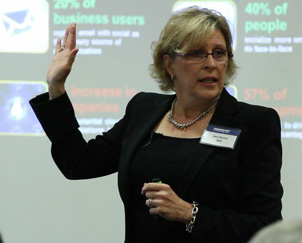
Dr. Jani Byrne
Director of Marketing, Cloud, IBM
We are delighted that Dr. Jani Byrne, Director of Marketing, Cloud, at IBM has joined the program for our 3rd annual MiniTrends 2014: Insight, Innovation & Strategy. Jani will be sharing her experiences as corporate innovator in her talk “Musings of a Wild Duck in a Big Pond.”
Jani is responsible for Content Marketing globally for Cloud, one of IBMs leading strategic initiatives, creating and distributing consumable, relevant content to drive client acquisition and purchase. Previously she served as IBM’s Director, Marketing Strategy for Global Mid-Markets MSPs and Director, Strategy.
Jani is on the Boards of The Seton Fund at the Seton Family of Hospitals’ and Austin Chamber of Commerce Technology Partnership.
Register Now for special price for full conference of only $150 until noon, Monday, September 22.
Our Keynotes are Austin Tech Leader and Bazaarvoice Founder Brett Hurt, top D.C. Futurist David Pearce Snyder, and award-winning author Dr. John Vanston. Also headlining is USA TODAY’s Road Warrior of the Year Joyce Gioia.

 We have an excellent applications panel on how to turbo-charge your success and profit by combining MiniTrends methods with your innovation strategy. Panelists include Raj Asava, Jeffrey Fry, Steve Pearson, Carrie Vanston, and Larry Vanston.
The breadth and depth of the speaking talent and schedule for this awesome event it exceptional. In addition we have incredible attendees who are thought-leaders in their own right. (See what our past attendees say.) We hope you, too, will be part of the this year’s amazing event.
MiniTrends 2014: Insight, Innovation & Strategy.
Friday, September 26, 2014
8:30 am – 5:30 pm followed by “Power Hour” Reception
Holiday Inn Lady Bird Lake, Austin, TX
Full Conference for Only $150
(Special ends Noon, Monday, Sept. 22)
All attendees receive Continental Breakfast, Breaks,
and Lunch followed by a Networking Reception!
Please share offer with your friends, colleagues & networks.
MiniTrends 2013 New Keynote IBM Director Dr. Jani Bryne — Oct. 2, Austin, TX
September 20, 2013

Dr. Jani Byrne, Director of Global Mid-Market Marketing at IBM, joins MiniTrends 2013 as Keynote
We are delighted to announce that Dr. Jani Byrne, Director of Global Mid-Market Marketing at IBM, has joined us as Morning Keynote at Technology Futures’ 2nd annual MiniTrends 2013: The Integration of Profit & Social Responsibility. She will be speaking on “The Next Generation IT Innovations and What’s in it For You.”
Dr. Byrne is a visionary who marries deep technological innovations and insights with a profound understanding of human and market psychology. She is an extraordinarily passionate thought leader who can also simply “get stuff done.”
In her present position, Dr. Byrne is responsible for end-to-end marketing strategies and plans for Mid-Market and Large Enterprise clients, across IBMs hardware / software / services portfolio, leading IBMs focus on Managed Service Providers worldwide. Previous positions have included Director of Strategy, where she created industry-leading strategies impacting IBM STG’s direction and activity, and Director of the IBM Venture Capital Group, where she was strategic liaison to the global Venture Community resulting in significant net profit to IBM.
In addition to her long distinguished career at IBM, Dr. Byrne is a Board Member of The Seton Fund at the Seton Family of Hospitals and Board Member of Austin Chamber of Commerce Technology Partnership.
 Conference Chair Dr. John Vanston, Chairman of Technology Futures and author of the award-winning book, MINITRENDS, notes “With Dr. Byrne’s broad knowledge and experience relating to past, current, and future trends, she brings a great deal of value to conference attendees looking for practical ideas and opportunities relating to their areas of interests. We are excited to learn more about ways we can find and take advantage of MiniTrends she sees on the horizon.”
Dr. Byrne, entrepreneur whiz Gary Hoover, and 19 other visionaries & thought-leaders will share leading-edge business ideas and what they see as MiniTrends–big opportunities not yet widely recognized–at MiniTrends 2013 on October 2-3 at the Holiday Inn Town Lake in Austin, TX. Please join us!
#####
Austin-based Technology Futures, Inc. is celebrating its 35th year of providing top-quality custom studies and technology forecasts on key trends to a wide variety of commercial, government, and academic organizations since 1978.
Turn on Automated Alerts to Tune Out Information Overload When Monitoring Trends
December 12, 2012

Photo Credit: http://technorati.com: http://scm-l3.technorati.com/11/12/12/58393/alert.gif?t=20111212034429
Part Two of a Two-Part Series by Guest Blogger Steve Pearson, Visionex Solutions, LLC
Automated alerts can help you stay competitive with real-time data about very specific subjects, technologies, authors and/or companies. Customizing state-of-the-art reports and automated alerts based on client-specified criteria are essential elements of my business, but there are some out-of-the box resources you may find useful.
Automated alerts can reduce your scanning time by notifying you about newly published information. For example, Google Alerts monitors a large portion of the web and emails you anything it considers relevant. Of course, you may not agree with Google’s version of “relevant” and you‘ll still spend valuable time scanning and sorting.
Fortunately, there are other many automated alerts. Setting each one up to deliver quality information and avoid overload is important.
Technical Alerts deliver bibliographic information regarding newly published research papers, dissertations and conference proceedings – if it meets your specified criteria. The data for these alerts originate from databases such as Compendex, which is one of the largest in the scientific field, currently indexing 1,031 journals from around the world. These alerts use the bibliographic information to provide tailored results.
Patent Alerts are keyed to patent and patent application information from around the world. For example, many companies like to know when a key competitor files patent applications or receives a granted patent.
RSS Alerts are different from RSS Readers because they allow you to “mine” the RSS streams of your choice for keywords that you consider important.
Web Page Alerts are simple in concept but they are extremely useful since they monitor a specific url for changes. Anytime the page changes you will receive a notification and that notification will allow you to view the new page changes highlighted. These alerts are especially valuable for monitoring product announcements from competitors, really long governmental pages or working groups.
Table of Contents (TOC) Alerts send you the TOC information for specific publications, typically weeks or months in advance of the publication date. These alerts are valuable not only for their speed but also because you can quickly glance through each TOC and purchase only those publications that are appealing. (And save money on subscriptions and/or memberships.)
Social Alerts typically monitor sites like Facebook, blogs and Twitter for keywords.
Government Alerts help keep you apprised of recently published research sponsored by the Federal Government and announcements of new solicitations of bids.
Business and Market Alerts are great because companies are constantly marketing themselves by making product announcements. Further, most market research companies will announce their newest reports covering specific industries or companies.
Trademark Alerts allow monitoring of specific company’s applications, monitoring your own trademarks for potential infringement or monitoring for key terms that you define.
Domain Alerts monitor new domain name registrations so that you can learn about new and potentially problematic names.
Many companies find that the best way to control their time and expense with Alerts is to hire an intermediary that not only has access to the services that charge money but also knows how to set them up properly.
Guest blogger Steve Pearson is a consultant helping companies accelerate innovation and product development. Through his firm Visionex Solutions, LLC, he delivers competitor-busting research with tools and reports he has developed over his career as an engineer, trainer and analyst.
Steve specializes in intellectual property management, technology identification and market assessment and takes pride in applying lessons from his broad background to help those in the electrical, mechanical, energy, construction or transportation industries. Visit his site for more information.
Put Aggregators to Work for Quality, Timely Info When Trend Searching
November 29, 2012
Part One of a Two-Part Series by Guest Blogger Steve Pearson, Visionex Solutions, LLC

Photo credit: www.mapthis.net: http://mapthis.net/wp-content/uploads/2010/11/searching-for-info.jpg
I was truly inspired by the recent MiniTrends 2012 Conference and collected many ideas for improving my business and for passing along to my clients.
After reading the MINITRENDS book, I’d like to share some additional technical and patent resources that might help others as much as they help me in my business providing research for product development and innovation.
Google is popular, but not a good source for piecing together trends: access to a large amount of content dumped in your lap through a single portal is not efficient.
Fortunately, there are information resources that provide broad data in a bibliographic form that facilitates finding the information you desire. There are three general groups of these resources:
- business/market
- engineering/science
- patents/patent applications
Of course, many of these specialty resources require fees, but they can be invaluable for businesses and researchers needing timely and accurate information.
Some options:
Business news typically consists of new product announcements, merger and acquisition news and management changes. Many executives find it valuable to monitor their key competitors or the top executives in those companies. There’s a wide breadth of providers in this category and some are free. A good place to start is doing a Google search, probably for a specific company’s name, and then filtering the results by clicking on “news” in the grey colored font immediately below the search box. (More on automated news alerts in Part 2 next week.)
Technical resources provide focused information related to newly published research, dissertations and conference proceedings. Consider Inspec which monitors roughly 5,000 scientific and technical journals plus some conferences and dissertations. These originate from around the world but often have an English abstract.
Technical services can be a pricey, but consider the savings the first time you rethink your current or upcoming R&D efforts based on information that your competitor may not know.
Patents and patent application aggregators collect updates from international patent offices and store this bibliographic information in their databases. Many countries make this information available to the public, but the ease of use varies dramatically.
For instance, the USPTO maintains its own search engine for finding relevant intellectual property, but there are several limitations:
- The information is focused solely on the U.S.
- Searching granted patents and patent applications is done through separate search windows
- The results shown to your inquiry will often require a lot of time to review.
- PDF file export is not available.
A better choice for many is Google Patents as it also covers Europe, is fairly simple to use, provides results that are easier to navigate and allows you to export PDFs.
So, why not use Google Patents for all of your work? There are drawbacks as well:
- It doesn’t cover the remainder of the world
- It’s difficult to drill down to the specific patents and applications that are most relevant to your need
- It’s difficult to do trend analysis
Many companies find that the best way to control their time and expense is to hire an intermediary to decipher these resources and conduct research as needs arise.
Next week: Where to Start with Automated Alerts
Guest blogger Steve Pearson is a consultant helping companies accelerate innovation and product development. Through his firm Visionex Solutions, LLC, he delivers competitor-busting research with tools and reports he has developed over his career as an engineer, trainer and analyst.
Steve specializes in intellectual property management, technology identification and market assessment and takes pride in applying lessons from his broad background to help those in the electrical, mechanical, energy, construction or transportation industries. Visit his site for more information.
MiniTrends 2012 Conference – Tomorrow – Oct. 17-18, Austin, TX
October 16, 2012
 Discover, Analyze, Profit! Tomorrow is MiniTrends 2012: A Conference on Translating Emerging Trends into Business Opportunities, October 17-18, 2012 at the Omni Austin Hotel Downtown, Austin, Texas. Register now and save $150 by using the discount code 2012Blog. (Promotional box is above green “Register” button.)
Twenty all-star business leaders and forward thinkers will discuss how you can start new ventures and grow established organizations through attention to MiniTrends–emerging trends that will soon become important, but are not yet widely recognized. Find out what future trends and convergences they see on the horizon and, just as importantly, how you can find profitable emerging trends of your own.
- An Entrepreneur wishing to identify, assess, and exploit attractive new business opportunities
- An Executive, Director, Manager, or Professional seeking to take advantage of important emerging trends
- An Innovative Thinker interested in gaining recognition for your originality and perceptiveness
- An Investor interested in uncovering attractive new investment opportunities
- A Job Seeker wishing to define emerging employment possibilities
Fun and entrepreneurial-spirited Austin offers the ideal location for to learn and network with others, while finding strategies and insights to create or grow their organization or find new avenues for job skills.
Don’t miss out on this extraordinary conference with such an exceptional depth and breadth of speaker talent and solid schedule. Save $150 by registering using the code 2012Bonus! (Promotional box is above green “Register” button.)
What you will gain:
- A creative mind-set and resources for finding and taking advantage of emerging trends and opportunities relating to your own area of expertise and interest
- A preview of MiniTrends that thought-leaders see developing
- Experience, knowledge, and wisdom from innovative leaders sharing how they use emerging trends to start new ventures or grow established organizations
- Tactics to identify untapped business opportunities from converging trends
- Interaction with speakers and fellow participants to learn, mix, and share ideas
- Strategy and insights to create or grow your organization and, in the process, find your bliss!
- An opportunity to enjoy the Live Music Capital of the World!
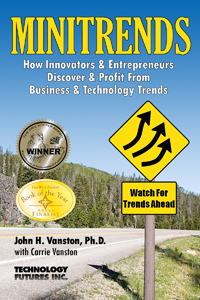 BONUS!!! In addition to information, ideas, and insights to participants for discovering, analyzing, and profiting from minitrends, all participants will receive the award-winning book MINITRENDS: How Innovators & Entrepreneurs Discover & Profit From Business & Technology Trends.
___________
MiniTrends 2012: A Conference on Translating Emerging Trends into Business Opportunities
Wednesday, October 17, 1:30 p.m. – 5:30 p.m. & Thursday, October 18, 8:30 a.m. – 5:30 p.m. followed by conference reception until 7:15 p.m.
Registration: $495 – Use code 2012BLOG and receive a $150 discount!
MiniTrends 2012 Conference – Only Five Days Left – Oct. 17-18, Austin, TX
October 12, 2012
Discover, Analyze, Profit! Only five days left until MiniTrends 2012: A Conference on Translating Emerging Trends into Business Opportunities, October 17-18, 2012 at the Omni Austin Hotel Downtown, Austin, Texas. Register now and save $150 by using the discount code 2012Blog. (Promotional box is above green “Register” button.)
Twenty all-star business leaders and forward thinkers will discuss how you can start new ventures and grow established organizations through attention to MiniTrends–emerging trends that will soon become important, but are not yet widely recognized. Find out what future trends and convergences they see on the horizon and, just as importantly, how you can find profitable emerging trends of your own.
- An Entrepreneur wishing to identify, assess, and exploit attractive new business opportunities
- An Executive, Director, Manager, or Professional seeking to take advantage of important emerging trends
- An Innovative Thinker interested in gaining recognition for your originality and perceptiveness
- An Investor interested in uncovering attractive new investment opportunities
- A Job Seeker wishing to define emerging employment possibilities
Fun and entrepreneurial-spirited Austin offers the ideal location for to learn and network with others, while finding strategies and insights to create or grow their organization or find new avenues for job skills.
Don’t miss out on this extraordinary conference with such an exceptional depth and breadth of speaker talent and solid schedule. Save $150 by registering using the code 2012Bonus! (Promotional box is above green “Register” button.)
What you will gain:
- A creative mind-set and resources for finding and taking advantage of emerging trends and opportunities relating to your own area of expertise and interest
- A preview of MiniTrends that thought-leaders see developing
- Experience, knowledge, and wisdom from innovative leaders sharing how they use emerging trends to start new ventures or grow established organizations
- Tactics to identify untapped business opportunities from converging trends
- Interaction with speakers and fellow participants to learn, mix, and share ideas
- Strategy and insights to create or grow your organization and, in the process, find your bliss!
- An opportunity to enjoy the Live Music Capital of the World!
BONUS!!! In addition to information, ideas, and insights to participants for discovering, analyzing, and profiting from minitrends, all participants will receive the award-winning book MINITRENDS: How Innovators & Entrepreneurs Discover & Profit From Business & Technology Trends.
___________
MiniTrends 2012: A Conference on Translating Emerging Trends into Business Opportunities
Wednesday, October 17, 1:30 p.m. – 5:30 p.m. & Thursday, October 18, 8:30 a.m. – 5:30 p.m. followed by conference reception until 7:15 p.m.
Registration: $495 – Use code 2012BLOG and receive a $150 discount!
Age of Imagination With MiniTrends – GigaOm Blog – Dr. John Vanston
October 6, 2012

Dr. John Vanston guest blog’s on GigaOm: “In the Age of Information, Small Trends have Big Impacts.” Image “future1” courtesy of GigaOm. Used under Creative Commons license.
Dr. John Vanston is giving a great opening presentation at MiniTrends 2012: A Conference on Translating Emerging Trends into Business Opportunities entitled “Succeeding in the Age of Imagination with Minitrends.” John gives a preview of the talk in his GigaOm guest blog In the Age of Information, Small Trends have Big Impacts. We highly suggest you read it.
We greatly appreciate Stacey Higginbotham‘s interest in publishing the article. We’ve been friends with Stacey since her days at the Austin Business Journal and are thrilled to see her success at the very prestigious GigaOm.
We still have opening for MiniTrends 2012! The breadth and depth of the speaking talent and schedule is exceptional. Twenty all-star business leaders and forward thinkers will identify impending trends and convergences and help you profitably exploit them. This is a must-attend event for entrepreneurs, decision makers, innovative thinkers, investors, and/or job seekers whose fortunes depend on seeing and seizing business trends. And fun and entrepreneurial-spirited Austin offers the ideal location.
Don’t miss out on this great opportunity to learn and network with others, while finding strategies and insights to create or grow your own organization or find new avenues for your job skills.
In appreciation for your being a MiniTrends Blog subscriber, register now using the code 2012BLOG and receive a $150 discount! Enter code in the “Enter Promotional Code” immediately above the large green Registration button.
___________
MiniTrends 2012: A Conference on Translating Emerging Trends into Business Opportunities
Wednesday, October 17, 1:30 p.m. – 5:30 p.m. & Thursday, October 18, 8:30 a.m. – 5:30 p.m. followed by conference reception until 7:15 p.m.
Register with code 2012BLOG and receive a $150 discount!
MiniTrends 2012 Conference – Early Registration Ends Today
October 3, 2012
- An Entrepreneur wishing to identify, assess, and exploit attractive new business opportunities
- A Decision Making Executive, Director, Manager, or in a Small or Mid-Size Business wanting to gain advantage by recognizing and utilizing emerging trends
- An Innovative Thinking Executive, Director, Manager, or Professional in a Larger Business aspiring to distinguish yourself by your special insights and perceptiveness
- An Investor interested in uncovering attractive new investment opportunities
- A Job Seeker wishing to define employment opportunities
You will gain:
- A creative mind-set and resources for finding and taking advantage of emerging trends and opportunities relating to your own area of expertise and interest
- A preview of minitrends that thought-leaders see developing
- Experience, knowledge, and wisdom from innovative leaders sharing how they use emerging trends to start new ventures or grow established organizations
- Tactics to identify business opportunities from converging trends
- Interaction with speakers and fellow participants to learn, mix, and share ideas
- Strategy and insights to create or grow your organization and, in the process, find your bliss
- Hanging out in the Live Music Capital of the World!
A day and half conference of this caliber is usually priced at $1,000 or much more. Register TODAY and pay only $395. The price is still a very reasonable $495 after that.
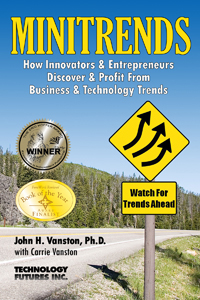 BONUS!!! All participants will receive the award-winning book MINITRENDS: How Innovators & Entrepreneurs Discover & Profit From Business & Technology Trends.
Take advantage of Early Registration and sign up TODAY! Don’t miss out on this great opportunity to learn and network with others, while finding strategies and insights to create or grow your own organization or find new avenues for your job skills.
___________
MiniTrends 2012: A Conference on Translating Emerging Trends into Business Opportunities
Wednesday, October 17, 1:30 p.m. – 5:30 p.m. & Thursday, October 18, 8:30 a.m. – 5:30 p.m. followed by conference reception until 7:15 p.m.
Early Registration: Only $395.00 until October 3 (then $495.00)



MiniTrends Recent Posts
- “International Dimensions of Strong Corporate Cultures” – Friday, April 1, 2016, Austin, TX
- Carrie speaking at IEEE Wed, Sept 23, 6pm
- Carrie Vanston speaks on Engagement & Innovation at WorldFuture 2015 – San Francisco, July 25
- Carrie Vanston presents “5 Keys to an Engaged & Innovative Culture” at CTXWFS, May 27, Austin, TX
- The Ultimate Quesiton – Do You Validate? World Champion Speech by Lance Miller


Home | MiniTrends | Book | Conference | Presentations | Media Center | About Us | Contact | Blog
MINITRENDS: How Innovators & Entrepreneurs Discover & Profit From Business & Technology Trends
by Technology Futurist John H. Vanston, Ph.D. with Carrie Vanston
© Copyright Technology Futures, Inc. All Rights Reserved.